

Beauty from Ashes
Beauty from ashes
What do you think of when you hear the word stepfamily? For many, the first image that appears is a villain from a Disney princess movie… Cinderella anyone? But what does that mean for the actual stepfamilies that attend church, or even more… for those that are afraid to attend church because they don’t feel the message of Christ includes them. I know, I once sat in the seats as a divorced woman, listening to sermons on marriage and feeling like not only did I not belong, but there was no “family” future for me beyond that of being a single parent. I felt like a failure… like I had lost my chance to belong in the community of Christians, at least as an equal. How about you- is there a part of your personal life story or family story that you wish you could change? At this point, does the tragedy in your story seem to define you?
Remarriage for my husband and I has been living proof of our Father and his love for us, his willingness to love and forgive and to redeem us in any circumstance. So many of us have had the chance to experience God’s grace, from alcoholics, drug addicts, abusers… people the church welcomes with open arms to accept God’s mercy and forgiveness. Divorce, remarriage… it’s not often discussed, but regardless of how you got there, you need and are worthy of God’s love and forgiveness, like everyone else. It is equally important in a remarriage to hold God at the center… remarriage is hard. And without God, I can’t imagine why you would push through the hard… with God, you have a purpose and reason. And remarriage is the opportunity to show your children God’s plan for marriage, regardless of all that they have experienced or continue to… you can show them God’s plan and redeem your family from the generational cycle of divorce.
So friends, why then does a church need a stepfamily, or blended family, ministry? If you are like us, you haven’t always felt that the studies and resources available, fully apply to our life situations. A Christian marriage study is awesome, so is a parent child study, but so much of the content is based on a first marriage and shared children…. leaving us always feeling a little left out, or with more questions about how that may apply to us, or what God wants for our own unique situations. We have found ourselves on a journey of finding help for just these questions… and for navigating through the traditional family tree, which is our own family forest, filled with complexities that many people don’t understand and have never had to deal with. And I can tell you… what we have discovered is amazing. God wants to use our stories in the same way he wants to use anyone else’s and with the unique lessons he teaches us on our paths. And more importantly, finding a group of people to share life with, who encounter similar, or the same issues we do, every day.
As Christians, our story is being caught up into God’s story, the story of his redemption of those who call upon His grace. It doesn’t really matter that you can’t change the past. What matters is that God is changing the trajectory of it. For example, the worthless, nonsensical parts of life can find purpose, and our tragedies can become service to others. What if remarriage and this
new family is the present-day portion of God’s redemptive work in your life? When you seek to demonstrate the fruits of the Spirit, you partner with God’s activity to move your family story out of the past and into a redemptive present. And here’s the amazing outcome of the far-reaching power of God’s redemption- when God works all things for the good of those who love him, it doesn’t change the past, but it does change the story we tell about the past.
“And we know that God causes everything to work together for the good of those who love God and are called according to his purpose for them.” Romans 8:28
You should know right now that God wants to work through your current marriage, parenting, and family relationships to redeem your story of loss, sadness, heartbreak, and brokenness, to offer healing, and to turn your home into a haven of safety that blesses your children. How life is now and how you got here may not have been how you would have written the script, but
given that you’re in the middle of the story already, God wants to author a redemptive narrative to the remaining chapters. When you walk with him in faith, your story, even the worst parts of it, is caught up into what he is doing to redeem all things to him. Your family story is still being written and the best is yet to come. Walk in faith and watch in awe how God authors a new legacy.
“To all who mourn in Israel, he will give a crown of beauty for ashes, a joyous blessing instead of mourning, festive praise instead of despair.” Isaiah 61:3
-Kristin Engler
When We Stop Chasing More
I don't know about you, but I often struggle with misusing many of the good things God has placed in this world. Food, work, hobbies and even sleep can become unhealthy focuses for me. And if I'm being honest, the list could go on.
I believe God gives us these things for our good. They are gifts from a loving Father who knows exactly what we need. He not only provides them, but also establishes healthy boundaries around them so they can be enjoyed as He intended. Yet despite knowing this, I often find myself drifting toward excess or giving something more attention, value, or importance than it deserves.
There have been seasons when I've lived within those healthy boundaries, and during those times I've experienced the freedom, peace, and joy that come from trusting God's design. I've seen firsthand why the balance He calls us to is so important. Yet even knowing that, I still find myself tempted to believe that more will somehow satisfy me when God's provision has already been enough.
Maybe that's why Proverbs 3:5-6 resonates so deeply with me: "Trust in the Lord with all your heart and lean not on your own understanding; in all your ways submit to him, and he will make your paths straight."
The struggle isn't usually that I don't know what God says. The struggle is whether I trust that His way is actually better than my own.
A few years ago, I went through a season of significant health challenges. It was a difficult time filled with symptoms, uncertainty, and countless appointments as I traveled from doctor to doctor searching for answers and healing. As the months went on, simply getting out of bed, especially after a sleepless night, wasn't always easy. Believe it or not, during that season I learned something truly life changing.
I'm a big fan of Brené Brown, and while listening to one of her podcasts, she talked about what it means to practice gratitude. She emphasized that gratitude isn't merely a feeling. It's a daily, tangible behavior. It's something joyful people intentionally practice, inviting joy into their lives through consistent focus on what is good. So I started small.
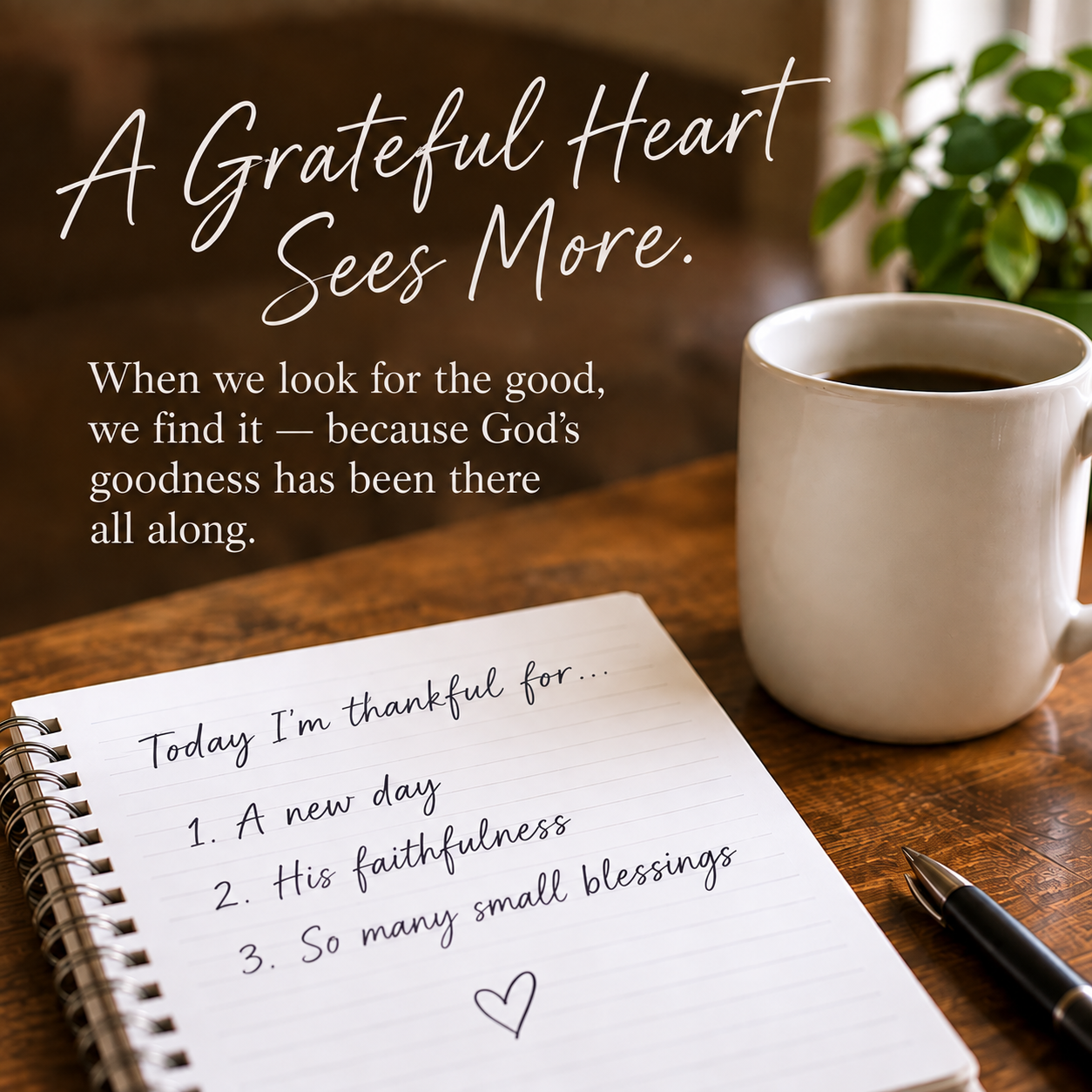
I bought a gratitude journal and made a commitment. Every morning, before starting my day, I would write down three things I was thankful for, no matter how small they seemed. Maybe it was the sun shining brightly through my window, the bird singing outside, or simply the few hours of sleep I had managed to get the night before. And friends, what happened next was amazing.
Those blessings didn't remain on the page. Throughout the day, they seemed to multiply. The good things that God was placing in my path suddenly became impossible to miss.
I remember one morning after an especially difficult night. I had barely slept. Every time I looked at the clock, another hour had slipped by. By the time my alarm went off, my body felt heavy, my stomach churned, and I was already exhausted by the thought of the day ahead. I had an early flight to Connecticut for work, and honestly, I wasn't sure I had the energy for it.
As I sat on the edge of my bed with my gratitude journal, thankfulness wasn't what came naturally. Complaining would have been much easier. But I wrote my three things anyway. A warm bed. A job I loved. The simple fact that God had carried me through another day.
The result was…little blessings started appearing everywhere.
At the airport, I found out I had been moved to a better seat. It wasn't a life-changing event, but it felt like a small reminder from God: I see you. Later, on my connecting flight, I managed to fall asleep for a short nap. For someone who had spent most of the night staring at the ceiling, those few minutes of rest felt like a gift. When I landed, two coworkers I genuinely enjoyed spending time with were waiting for me. Their laughter, encouragement, and companionship gave me energy I didn't have when I started the day.
The funny thing is that none of my circumstances had really changed. I was still dealing with the same health issues. I still didn't have answers. I still wasn't feeling well. But my attention had changed. Instead of looking for reasons that the day would be difficult, I had started looking for evidence of God's goodness. And once I started looking, I saw it everywhere.
What I discovered was simple but profound: when we focus on the negative, we will always find more negativity. But the opposite is also true. When we focus on the goodness of God and the gifts He places before us, we begin to notice how present those gifts have been all along. God's heart for us is good. His desire for us is joy.
That doesn't mean every circumstance will be easy or that only good things will happen. Life in a fallen world is still hard. But even on our most difficult days, God is present, and there are still evidences of His grace if we choose to look for them.
This leads me to an important question: Why are we so often dissatisfied with what God has given us? Why do we so easily believe that what we have is not enough, or even that God Himself is not enough?
If He loves us enough to create and provide so many good gifts, why do we often feel compelled to push beyond the boundaries He has established for them? Why do we overuse, misuse, or abuse His gifts instead of simply enjoying them with gratitude?
God is good. He is good to us. And because He is good, the gifts He gives are good as well.
Food, intimacy within marriage, friendship, community, rest, and recreation. These are all gifts from a loving Father, designed to bring enjoyment and enrichment to our lives. Yet when we stop trusting God's wisdom and begin following our own desires, we often lose sight of the purpose of those gifts. Rather than receiving them with gratitude, we consume them according to our own rules and expectations.
The problem is rarely the gift itself. More often, the problem is our lack of contentment. We look to God's gifts to satisfy needs that only God can satisfy. We seek comfort, identity, peace, security, or fulfillment in created things instead of in the Creator. And when we do, "enough" never feels like enough. True contentment is different.
Contentment is not settling for less. It is trusting that God knows what is best and that what He has provided today is sufficient for today. It is receiving His gifts with gratitude, enjoying them within His design, and recognizing that our deepest joy is found in Him rather than in the gifts themselves.
Contentment, peace, and joy all grow from gratitude. They flourish when we focus not on what we lack, but on what God has already given us. When we trust Him, we discover that He truly is enough.
Perhaps contentment begins with believing that God is actually telling us the truth about who He is. That He is good. That His boundaries are good. That the gifts He gives are good. And that when He calls us to enjoy those gifts with gratitude and self-control, it isn't because He wants to withhold joy from us, but because He wants to protect it.
When we trust His heart, we stop chasing "more" and begin appreciating "enough." We find peace not in having everything we want, but in knowing that the One who provides for us knows exactly what we need. As we learn to trust Him, practice gratitude, and embrace contentment, we discover that His way truly is the better way.
For I know the plans I have for you,” declares the Lord, “plans to prosper you and not to harm you, plans to give you hope and a future." Jeremiah 29:11
-Kristin Engler
The Ministry of Presence
Why Presence Is More Powerful Than Advice
I was tired, literally and emotionally. I had been ill for years. My symptoms kept increasing, yet the doctors still had no answers. People were incredibly kind, checking in on me and offering support. But sometimes, I wished they didn't have so many suggestions.
The worst symptom for me was the insomnia. By that point, it had been going on for nearly a year, and I can assure you, I had tried everything: staying on a schedule, winding down before bed, avoiding screen time, keeping the room cool, cutting off caffeine after 1 pm…the list went on and on. There was rarely a suggestion I hadn't already heard, and even fewer that I hadn't already tried. Over time, I grew weary of people still trying to fix it.
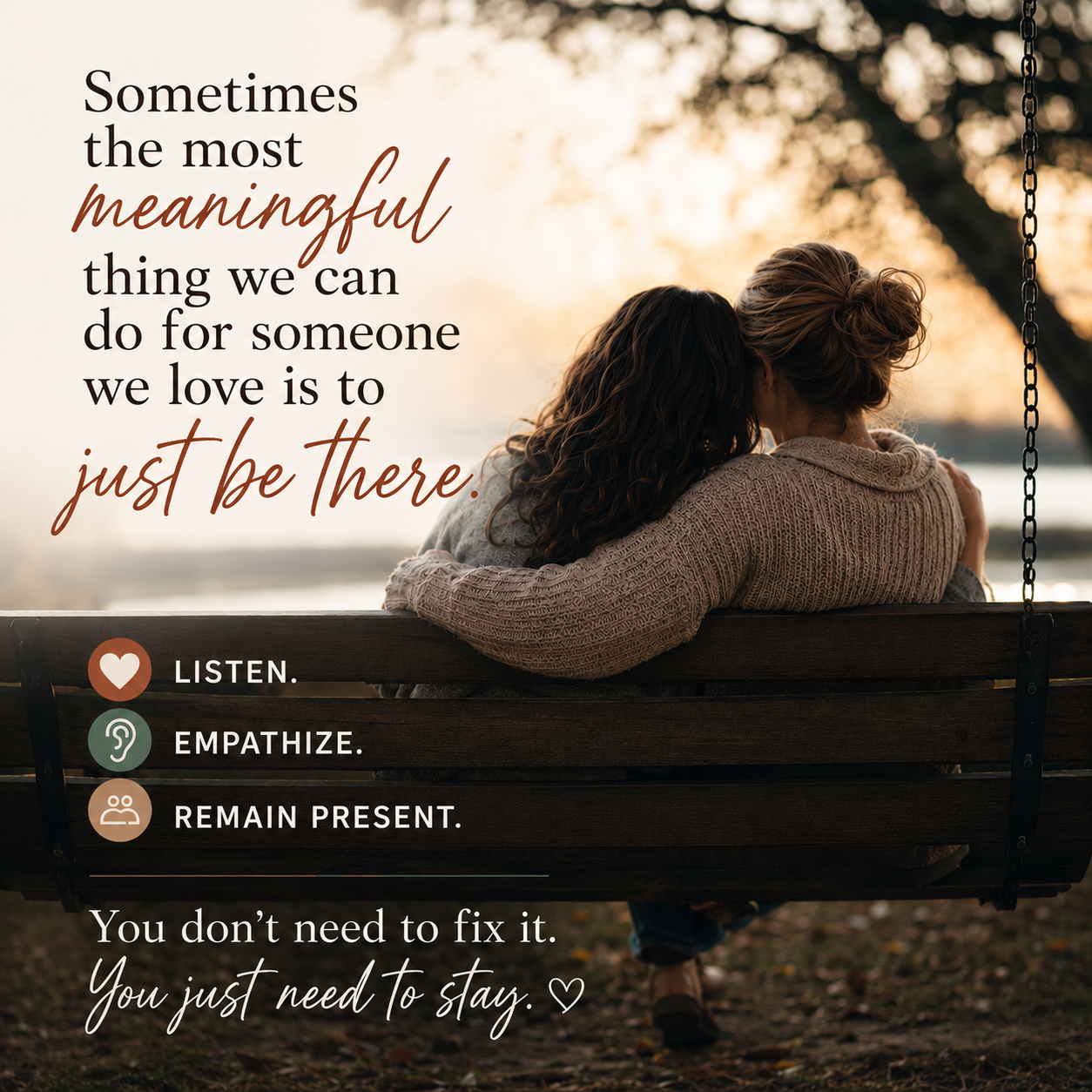
Then one day, I sat down on a park swing with a close friend and shared some of what I was carrying. Between the illness and family challenges, life felt overwhelming. She paused, looked at me, and simply said, "I'm so sorry, Kristin. That really sucks." And we just kept swinging.
In that moment, I felt more heard, more understood, and more loved than I had in a long time. She acknowledged the difficulty without trying to solve it. She didn't offer advice or suggest another remedy. She simply sat with me. And in that moment, her presence eased my burden more than any solution ever could.
Why are we so quick to provide solutions when someone comes to us with a challenge? Why do we feel compelled to explain, advise, or fix? Why do we often rush to understanding a problem rather than simply being present in it?
In the Garden of Gethsemane, Jesus returned twice to find His friends sleeping while He prayed. Earlier He had told them, "My soul is crushed with grief to the point of death" (Matthew 26:38). Jesus wasn't asking them to solve His suffering. He wasn't looking for answers. He simply wanted His friends to stay awake, keep watch, and be present with Him in His darkest hour.
There is much we can learn from Jesus here. If anyone faced a burden beyond human comprehension, it was Him. Yet what He desired from His closest friends was not advice or solutions, but companionship. He wanted them to pray with Him, remain near Him, and share His sorrow.
Archbishop Rowan Williams reflected on Jesus' final night before the cross:
"When Jesus gives thanks at that moment before the breaking and spilling, before the wounds and the blood, it is as if He is connecting the darkest places of human experience with God the Giver; as if He is saying that even in these dark places God continues to give, and therefore we must continue to give thanks."
Jesus teaches us how to suffer, how to grieve, and ultimately how to sacrifice. Yet He also demonstrates something profoundly human: the need for compassion, friendship, and presence. On the eve of the greatest suffering He would ever endure, Jesus simply wanted His friends to be with Him.
The story continues with Jesus acknowledging that one friend would betray Him and the others would abandon Him in His trial. And yet, knowing all of this, He continued to love them. So why do we struggle to do the same for those around us?
What would it look like if, when our spouse shared a challenge at work, we resisted the urge to immediately solve it? What if, when our child talked about a disagreement with a friend, we focused first on understanding their feelings rather than offering advice? What if, instead of searching for the perfect answer, we embraced the power of simply being present?
Sometimes the most meaningful thing we can do for someone we love is to sit with them in the discomfort. Not to explain it away. Not to offer a list of solutions. Just to be there; to listen, to empathize, and to remind them they are not alone.
There's a children's book called The Rabbit Listened that beautifully illustrates this idea. A little boy named Taylor builds a tower, only to watch it come crashing down. One by one, different animals appear with suggestions for how he should respond. Some want him to talk about it, others want him to get angry, and still others want him to move on. But none of their solutions help.
Then the rabbit arrives.
The rabbit doesn't offer advice. He doesn't tell Taylor what to do or how to feel. He simply sits beside him. As Taylor works through his anger, sadness, frustration, and eventual resolve, the rabbit remains present. He doesn't judge. He doesn't fix. He just loves. What would it look like if we did the same for the people in our lives?
How much comfort could we bring if, instead of rushing to solve someone's pain, we simply acknowledged it? What if we chose to sit with those we love in their struggle, offering the gift of our presence as they find their way through?
Perhaps one of the greatest gifts we can give another person is the assurance that they do not have to suffer alone. When someone shares their hurt, they are not always asking us for answers. Often, they are simply asking us to stay, to listen, and to care; To remain beside them in the uncertainty.
Jesus modeled this for us. In His darkest hour, He invited His friends to be present with Him. And while they fell short, His invitation remains a lesson for us today. We may not be able to take away another person's pain, but we can enter into it with compassion. We can bear witness to their struggle. We can remind them, through our presence, that they are loved.
Sometimes the most Christ-like response is not found in the wisdom we offer, but in the quiet faithfulness of simply staying near. In a world eager to fix, explain, and move on, perhaps we are called to something different: to sit with one another in both joy and sorrow, reflecting the heart of a Savior who never leaves us alone.
-Kristin Engler

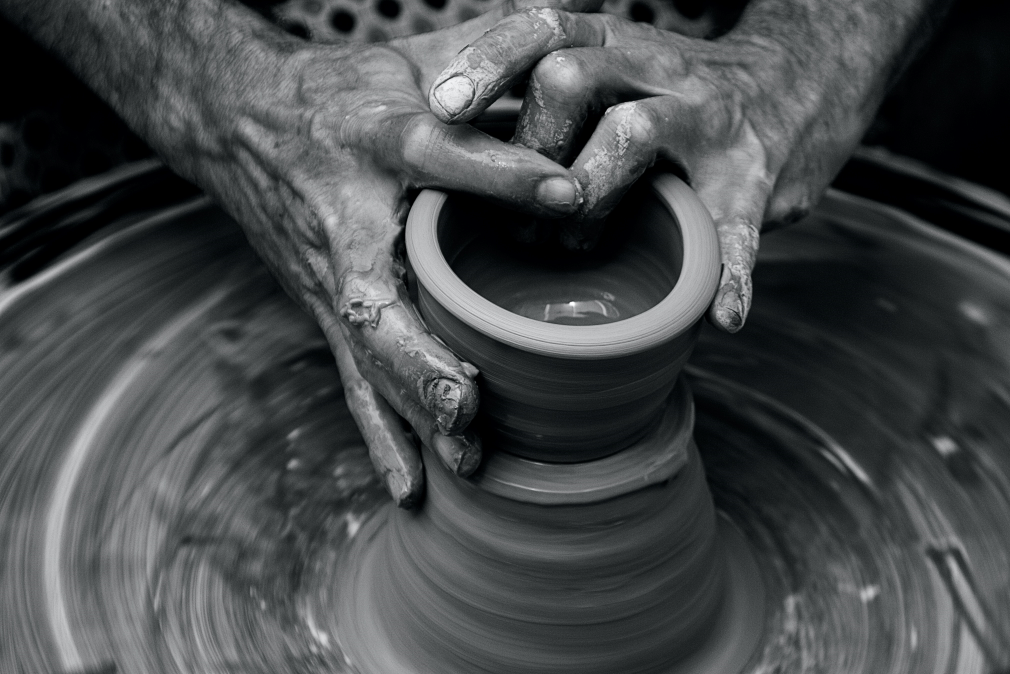
Stripped, Sanded, and Restored
Alright, so bear with me here… I want to share something that’s been on my heart, and sometimes the easiest way for me to do that is through an analogy.
One of my favorite hobbies has become refinishing furniture. I truly love every part of the journey, from finding an imperfect piece to witnessing, and even participating in, its transformation. I’ve learned where to look, often wandering through antique stores in search of just the right piece for a particular space or purpose. And surprisingly, one of my favorite parts of the process has become the very beginning, the deconstruction.
There is something deeply restorative about washing away years of dirt and wear, then sanding through layers of paint, stain, or lacquer that have accumulated over time. With each layer removed, the foundation begins to emerge and with it, a renewed sense of beauty and purpose. What once felt worn or overlooked slowly comes back to life, becoming something meaningful, intentional, and whole again.
In many ways, I’ve come to realize this process mirrors what God does in us.
As it says in 1 Corinthians 3:6–7, “I planted the seed in your hearts, and Apollos watered it, but it was God who made it grow. It’s not important who does the planting, or who does the watering. What’s important is that God makes the seed grow.” Growth, true growth, has never been ours to manufacture, it has always been His work.
There was a time in my life when I thought I had everything figured out. In reality, I was just at the beginning. I couldn’t yet see the layers that needed to be stripped away or the ways my heart needed to be reshaped. But God could. He saw me not only for who I was, but for who I was created to be. And through time, faith, and the unfolding of life, He began that refining work: slowly, intentionally, and with purpose.
That work hasn’t ended. It continues even now, shaping me in ways I couldn’t have imagined and drawing out growth I never could have accomplished on my own. And as I’ve walked through that process, I’ve come to see how closely it reflects the journey of marriage.
When I look at my husband and the life we’ve built together, I see a shared story of refinement. We started with a strong foundation, but like anyone, we’ve faced challenges along the way. There have been seasons of deep connection and others that required more patience, more grace, and a willingness to lean in when it would have been easier to pull away.
Yet through every season, one truth has remained constant: God has been present in the process.
Marriage doesn’t grow overnight. It isn’t effortless or instantaneous. It is built over time, through patience and grace. It is the slow sanding of rough edges. It is the surrender of control and the quiet realization that not everything needs to look the way we once thought it should. It’s also the understanding that we are each walking our own journey with God, and that one of life’s greatest gifts is getting to walk that journey side by side.
One of the most humbling lessons I’ve learned is this: transformation in marriage doesn’t begin with changing the other person. It begins with allowing God to change me. As He softens pride, deepens grace, and grows patience within my own heart, it transforms the way I love and the way I show up each day.
Looking back on the early days of our relationship, I feel a deep sense of gratitude. There was so much hope, so many dreams, and perhaps a little less awareness than there is now. Those moments were meaningful and formative, but they were only the beginning.
What feels even more meaningful is who we are today.
As Ephesians 4:14–15 reminds us, “Then we will no longer be immature like children… Instead, we will speak the truth in love, growing in every way more and more like Christ.”
That kind of growth: steady, maturing, rooted in love, isn’t accidental. It is the result of a life continually surrendered to God.
Today, there is a deeper sense of presence. A stronger appreciation for what truly matters. A shared understanding that progress matters more than perfection. Instead of constantly striving for what’s next, we’ve learned to be more intentional about where we are and to recognize that none of this growth is possible apart from the love and grace of a sovereign God.
When I look at my husband now, I still see the man I fell in love with, but I also see a man who has been refined by time and shaped by God. That growth has made our marriage steadier, richer, and more meaningful. And in witnessing that, I’ve come to recognize how much God has been doing in me, too, teaching me to see more clearly, love more deeply, and appreciate more fully what was always there.
If there’s one truth this journey continues to reveal, it’s this: real, lasting growth comes from God. Not just in our individual lives, but within our marriages. When we allow Him to strip away what doesn’t belong, to strengthen our foundation, and to guide what lies ahead, the transformation becomes something far greater than anything we could create on our own.
Marriage, much like refinement, isn’t about perfection, it’s about restoration. It’s about becoming what we were always meant to be, redeemed by a God whose love far exceeds anything we deserve.
And the beauty of it all is this: We were never meant to do it alone.
-Kristin Engler
When God Says ‘Not Yet’
But Joseph said to his brothers, “Don’t be afraid of me. Am I God, that I can punish you? You intended to harm me, but God intended it all for good. He brought me to this position so I could save the lives of many people.” Genesis 50:19–20
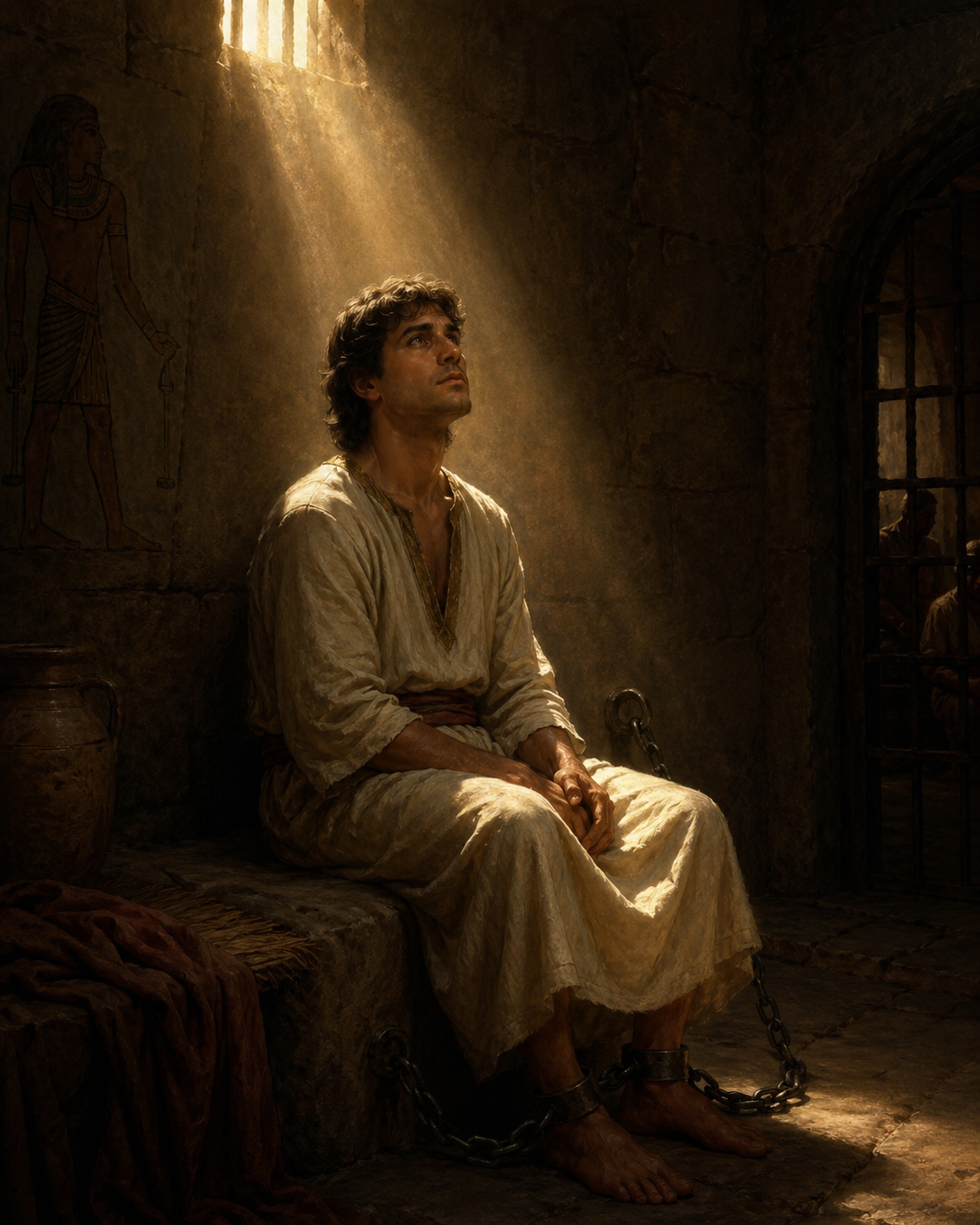
This is a powerful statement, made by a man whose own brothers sold him into slavery, who was punished for a crime he did not commit, and who was ultimately left to rot in prison for years. Throughout Joseph’s story, there are multiple moments when it feels like God is about to rescue him, about to pull him out of trouble, only for Joseph to fall into an even deeper place of despair.
While imprisoned and completely innocent, Joseph interprets the dreams of two of Pharaoh’s servants, clearly giving God all the glory: “Interpreting dreams is God’s business.” One of those men is released from prison just as Joseph said he would be, yet he forgets Joseph entirely. Not for a few days or weeks, but for TWO more years… So how is Joseph able, years later, to speak so confidently about the goodness of God that resulted from such deep suffering?
I want to share a story of my own, one that reflects how God shows up for us in much the same way He showed up for Joseph. Often, it’s not in the way we expect, and rarely on the timeline we want. Several years ago, Jason and I were in the middle of our first custody battle with his ex-wife. It had been grueling to get as far as we had, but we finally reached what looked like a hopeful agreement, one that would bring the kids closer to us and simplify the chaos and constant travel that defined the early years of our marriage.
We were prepared to move forward, agreeing to all the conditions (even some that felt incredibly imbalanced) because we believed the benefits would outweigh our concerns. Around that same time, I was driving and listening to a sermon by Andy Stanley called “Pay Attention to the Tension.” He encouraged listeners to pause and examine feelings of unease or internal “red flags” before making decisions. As I listened, the tension I had been suppressing suddenly spoke loudly. I had genuine fears about some of the parameters we were being asked to accept and how they could impact our very new marriage. Yes, it was incredibly important to create stability and peace for the kids, but we couldn’t do that effectively if our own relationship became disconnected or conflicted.
I shared the sermon and my concerns with Jason, and we prayed. It’s hard to fully explain the complexity of the decision we were facing, but we truly believed the kids needed to be closer to us, especially given the violence they were experiencing away from our home. Yet in prayer, God clearly guided us not to move forward. He assured us of His presence and grace, but He made it clear: it was not yet time. Friends, that decision was incredibly hard.
When we told our attorney we couldn’t agree to the final piece of the negotiation, she actually paused and asked me to stop talking so she could confirm directly with Jason that this was what he truly wanted. It meant the kids would not move closer. They wouldn’t be in our school system. And our already chaotic schedules would continue for an unknown length of time.
But in that decision, God moved in unexpected ways. He normalized schedules, created healthier rhythms, and gave us more meaningful time with both the kids and each other. He also established boundaries that helped protect us from the constant instability we had been navigating. Three years later, as the unhealthy situation continued for the kids, we returned to court. It was no easier than the first time, but during those three years, our marriage had grown stronger. We had leaned into both personal and marital counseling and continued growing closer to God and to one another. And then God moved—in His time. As a result, so much good came from the time before, during, and after we were finally awarded full custody.
I wish I could say those years were easy, but they weren’t. There were significant challenges for all of us, including the kids. But there was also growth… growth in faith, in maturity, and in our ability to parent from a place of health and unity. God used that waiting to prepare us for the responsibility He was about to entrust to us. I imagine Joseph in a similar way, knowing he had faithfully interpreted both servants’ dreams, watching one of them walk free, and then waiting… and waiting… two more years…seven hundred and thirty days in a prison cell, with nothing to do but either lean away from God, or lean into Him.
So when Joseph is finally called before Pharaoh and asked to interpret his dreams, his response is simple and humble: “It is beyond my power to do this, but God can tell you what it means and set you at ease.” From that moment, Joseph becomes second-in-command in all of Egypt. He flourishes as a leader and is eventually reunited with the very brothers who betrayed him. And instead of responding with anger or revenge, he declares, “What you intended for evil, God intended for good.”
Friends, God is good, All the time. And All the time, God is good. He rarely works on our timeline, but He always works on the right one. We may not understand His delays, but we can trust His heart. We can lean into Him, commit to obedience, and allow growth to happen in the waiting. Sometimes we get the gift of seeing why God waited. Other times, it may never fully make sense to us. But this I know: God is always at work behind the scenes… for our good and for the gift of eternity He has promised us.
-Kristin Engler

The Pause That Protects Love
“Hurry is the great enemy of spiritual life.” — Dallas Willard “Hurry” doesn’t only describe our schedules—it describes our reactions, our emotions, and the pressure we feel in moments of conflict. I was reminded of this truth during an argument with my husband not long ago.
“Jason, I’m calling a time out. We need to take a break and come back to this once each of us has settled down,” I said as I walked down the stairs toward my office, my husband right behind me. “I’m not done—I need you to hear what I’m saying…” he insisted. And honestly, I still had plenty I wanted to say too. But I knew that if we kept pushing forward in that hurried emotional state, nothing good was going to come of it. We needed space.
When we came back to the conversation later, both of us had softened. We’d each had time to reflect on what was really beneath our strong reactions. We listened better. We spoke more gently. We understood each other more clearly. Let me be clear—I wasn’t always good at this. It took time, counseling, and lots of trial and error to recognize the moment when an argument was no longer productive and when a break was desperately needed. I wanted to be understood just as much as he did, but as tension rose, I would withdraw, and neither of us was operating from a healthy place anymore.
Sometimes the holiest thing we can do in a heated moment is to slow everything down. When we’re in conflict—especially with the people closest to us—we feel an urgency rise within us. The urgency to be understood. The urgency to defend ourselves. The urgency to solve the problem right now. But that urgency is rarely from the Holy Spirit. More often, it comes from our woundedness, our fear, or simply our pride. Willard often taught that spiritual transformation happens in the “unhurried spaces” of our lives. When we rush, our souls constrict; when we slow down, our hearts open.
That’s true in prayer, in daily life—and absolutely in marriage. When we take a moment to pause, breathe, and step away, we are doing more than stopping an argument. We are creating room for God to work. There are times in conflict when we become emotionally “flooded.” Dr. John Gottman uses this term to describe the physiological and psychological overwhelm triggered by intense anxiety during conflict. Our brains are wired for self-protection, and when emotions escalate, they push us toward taking a pause. It’s not just helpful—it’s necessary—to let our nervous systems settle so we can actually engage in a healthy, rational conversation.
Scripture echoes this wisdom. James writes:
“Everyone should be quick to listen, slow to speak and slow to become angry, because human anger does not produce the righteousness that God desires.” — James 1:19–20
But when we’re flooded with emotion, we are anything but slow. We are in a frantic, hurried internal state. Our bodies go into fight or flight mode. Our thoughts race. Our hearts pound. Our words get sharper, louder, or more desperate. In that state, wisdom is nearly impossible. Pausing isn’t just a communication technique—it’s a spiritual practice. It’s choosing to step out of hurry and invite God into the moment. It’s making space for peace to re-enter the room. When my husband and I took a time out that day, we weren’t just cooling off—we were slowing down enough to hear God’s voice again and to remember who we were to each other.
And yes, this took time to learn. It took counseling. It took mistakes. It took many moments when we allowed hurry to take over, and we paid the relational price. But slowly, we discovered a different way—a way marked by patience, gentleness, and a deliberate slowness that helped us return to each other with clearer minds and softer hearts.
This is what Willard meant. Hurry isn’t just about schedules. It’s about the internal rush that pulls us away from wisdom, compassion, and presence. The enemy uses hurry to fracture relationships; God uses slowness to restore them. If you’re in a heated argument—heart racing, stress rising—there is almost zero chance you’re being quick to listen or slow to speak. That’s why taking time to calm down matters. Step back. Remember you love your spouse. Assume the best. Create space so you can show up as your best, most Christlike self before continuing the conversation.
What I’ve learned again and again is this: if I want to be authentic, vulnerable, and loving in my marriage—and if I want to make room for my spouse to be the same—I have to come into the conversation with a peaceful heart. And sometimes, friends, that means taking a very necessary time-out.
-Kristin Engler

“Living Water, Lasting Love: Honoring Joanne Smith’s Legacy of Choosing Jesus”
I will always remember the smile on her face and the twinkle in her eye—a radiance of pure joy, softened with a hint of mischief that made you instantly want to know her more. She was the giver of warm, enveloping hugs, and she possessed a quick, spirited wit that revealed just how deeply she understood life, love, and the human heart. Within her lived a depth of compassion and grace unlike almost anyone I have ever known.
I remember the morning I first met my beautiful friend, Joanne Smith, at church. It was an ordinary Sunday, but the moment she greeted me, I felt an extraordinary joy — the unmistakable warmth of encountering a soul both welcoming and wise. In the same breath, I felt something else too: recognition. A quiet certainty that this was a sister I had somehow known all my life.
She loved me instantly. There was no judgment, no hesitation — only encouragement, kindness, and an unwavering belief in the grace and love of God. To be seen by her was to feel gently lifted toward the person God created you to be.
So, as I try to write about the meaning of love, the choice to love, the way love itself is rooted in God, I find my mind continually returning to Joanne’s steadfast example. 1 John 4:6 says, “God is love, and all who live in love live in God. We know how much God loves us, and we have put our trust in his love.” And so the question naturally arises: can a person truly know love if they do not know God? I suppose my heart answers: not fully…
Which has me pondering, what in fact, is love? The dictionary offers worldly definitions it says an intense feeling of deep affection, a great interest or pleasure in something, and a feeling of deep romantic attachment to someone. But I think those descriptions fall painfully short. They describe emotion, not transformation. Preference, but not sacrifice. Comfort, but not redemption. And so my mind drifts back to the unconditional love I received from my friend.
One of the clearest demonstrations of Jesus’ heart appears in John 4, when He meets the Samaritan woman at the well. Jesus breaks social, gender, and religious barriers to encounter an outcast — not by accident, but by choice. He engages her, speaks to her, and offers her an invitation to love that transcends her past, her status, and her shame. When He asks her for a drink, she is stunned that He — a Jewish man — would not only be present in Samaria but would address her at all. And Jesus responds with words that echo through all eternity: “If you only knew the gift God has for you and who you are speaking to, you would ask me, and I would give you living water.” John 4:10.
Jesus sees her — not her mistakes, not her labels, not her limitations. He sees her. And He chooses love. My friend Joanne lived that way too — with intentionality, patience, gentleness, and a quiet courage that always chose compassion first. Love, then, is not simply a feeling. Love is a decision. Love is a verb — an action that calls us to show up again and again with consistency, honesty, and accountability. Love fulfills the promises it makes. Jesus offers living water freely, even though the woman has done nothing to earn it. That is the pattern He sets — a love so complete it defies human explanation. How do we describe a love willing to sacrifice everything for us, to endure an undeserved fate so we could receive a gift we could never earn?
As John 3:16 reminds us: “For God so loved the world that He gave His one and only Son…” Without Jesus, I’m not sure love can ever be fully understood. It is His grace — His boundless, relentless love — that forms the essence of this divine action. And then… I think of my friend.
A warm glow rises in my chest because I know exactly where she is. Joanne is with Jesus now — held in the fullness of the love she reflected so beautifully on this earth. Though she has stepped beyond our world, her spirit, her laughter, her tenderness, and her unwavering faith remain deeply woven into the lives of those she touched. Her decision to love — again and again, without condition — set her apart. Her faith in God shaped the story of her extraordinary life.
So what does it mean to love? To truly love? It means to know God. Because without Him, every earthly definition will always fall short. My friend chose Jesus. She chose love as her daily posture, her offering, her legacy. And because of that choice, she is forever imprinted on my heart. Forever part of my story. Forever a reminder of the kind of love that looks like Jesus.
-Kristin Engler

God Sees the Masterpiece
“No circumstance, person, or difficulty can stop the plans and promises of God.” — David Jeremiah
What does it mean to say that the plans of God are unstoppable? If God is good, and I know He is, why does our daily journey feel so hard? Why do we work so tirelessly to control everything we can?
On this side of eternity, I deeply love Jesus, but I often struggle to reconcile that love with the hardship I face. Fear creeps in, and I want to own my path, self-arranging to make sure things flow smoothly and outcomes match my plans. I grip tightly to every detail, trying to prevent difficulty. But here’s the truth: my fear and my striving provide no real relief.
Have you ever spent so much time trying to control an outcome that you ended up frustrated with the lack of progress? And then, when you finally reached the other side, you looked back and saw the resolution in a way you never could while you were in the trenches?
Friends, when we pause and reflect on the sovereignty of our Father, what makes us think we know better than He does? Why do we fight so hard for the limited outcome we see when we serve a God of infinite possibilities? It’s human nature, the facade of control. Yet the beauty of Jesus is this: the more we let go, the more we realize our utter lack of control. My power is an illusion, and my fear only limits my ability to trust God’s infinite goodness.
As we grow older, we mature as Christians. I don’t think maturity is about gaining wisdom as much as it is about learning to surrender. Experience teaches us that God is always good, even when we can’t see or understand His plans. If love for Jesus is at the base of our hearts, what can fear add? Nothing. True growth comes when we understand this: we need more of Him and less of us.
So what can we do? We can pray. We can lean into Jesus for guidance, peace, and discernment. Picture this: you’re staring at a stained-glass wall and can only see the color right in front of you. But God sees the entire masterpiece. Prayer is the best way we can seek clarity and build trust. Not to control, but to know the heart of our Father and to trust Him. Prayer plants the seed of faith that grows deep roots, connecting us to the One who truly holds control. Not so we can predict what’s coming, but so we can trust that whatever comes is good.
But what about the bad things that happen in this world? Jesus answered that:
“I have told you all this so that you may have peace in me. Here on earth you will have many trials and sorrows. But take heart, because I have overcome the world.” John 16:33
Friends, God never promised life would be easy. He actually told us the opposite. But here’s the good news: in the midst of every struggle, we can cling to the truth that He has already overcome the hardships of this world. And at the end of it all, if we simply believe and follow Him, an eternity of joy awaits us. When we lean into prayer, release our grip on control, and let God lead, we are planting seeds of faith. Those seeds grow deep roots, and where roots grow, a strong and flourishing tree will surely rise.
-Kristin Engler

Christ at the Center
Keep God and your relationship with Him in the center of your life.
“A woman’s heart should be so hidden in God that a man has to seek Him just to find her.” — Maya Angelou
“Men, you’ll never be a good groom to your wife unless you’re first a good bride to Jesus.” — Tim Keller
I’ve loved these quotes for years, but I never fully understood their depth until walking through the first years of our marriage.
My husband and I have been married for over seven years now. You might think, That’s not very long. But here’s some perspective: we are remarried. We each came into this marriage with two children and a lot of baggage. Over these years, we’ve faced more trials than I could have imagined including two grueling custody battles, chronic illness, four kids each wrestling with hardship (two battling immense trauma and suicidal thoughts), and the lingering ghosts of past relationships. Honestly, the list could go on. But what matters most is this: in seven years, we’ve walked through valleys deeper than we ever expected.
When you enter marriage, especially remarriage, you see everything through an idealistic lens. You love Jesus, you love each other, and you dream of a perfect new family. It feels like a dream come true. You’ve found “the one” who completes you. And let’s be honest: you can’t imagine real difficulty. But then life happens. The honeymoon fades. For many couples, that shift comes gradually as responsibilities grow bigger jobs, children, bills. For us, the challenges began immediately.
So, back to those quotes. At first, neither of us truly understood them. We loved Jesus and sought His grace. We wanted to show that love to each other and our children. But here’s what we learned: we both had to be so desperate for God that we sought Him first—before anything or anyone else, even each other.
My favorite picture of this is a triangle: God at the top, husband and wife at the bottom corners. As each of us grows closer to Christ through faith, trust, obedience the two of us grow closer together. The Holy Spirit strengthens the bond. Because how else can we, as selfish humans, love as generously and selflessly as Jesus? Marriage is a gift from God, a reflection of His relationship with us. It teaches us to lay down ourselves and put the relationship first. When Christ is at the center, He gives us the capacity to love like Him.
I used to struggle with God’s instructions for marriage not out of resistance, but lack of understanding. Living through hardship and seeking grace only He can give has made those words come alive:
“For wives, this means submit to your husbands as to the Lord. For a husband is the head of his wife as Christ is the head of the church… As the church submits to Christ, so you wives should submit to your husbands in everything. For husbands, this means love your wives, just as Christ loved the church. He gave up his life for her to make her holy and clean, washed by the cleansing of God’s word.”
— Ephesians 5:22-26
Jesus died for us so we could be forgiven. His sacrifice gives us the gift of eternity if we believe. That is a love beyond human comprehension but not beyond our Heavenly Father. The only way to truly grasp God’s plan for marriage is to seek Him first. None of us will ever perfectly mirror Jesus on this earth, but the closest we can come is to pursue Him with all our hearts. In that pursuit, He blesses our marriages with a love only possible when He is at the center.
As C.S. Lewis wrote, “Being in love is not merely a feeling. It is a deep unity maintained by the will and deliberately strengthened by habit; reinforced by the grace which both partners ask, and receive, from God.”
Friends, I encourage you: pursue Christ with all your heart and soul. The blessing that brings to your life and your marriage is a gift beyond comprehension.
-Kristin Engler