HONOR IN ROME
I can imagine, maybe Phoebe (Romans 16:1), running into Rome, clutching the leather bag slung over her shoulder. Past food vendors, roadside merchants, wagons, and thousands of busy people. As the city got bigger. She got smaller. And the contents of her bag: world-changing.
Word traveled fast among the Christians in Rome: the apostle Paul had sent them a letter. And there were far too many believers scattered across the city to hear it read all at once. So for the next few weeks, that letter would make the rounds. House to house. Courtyard to courtyard. Rented rooms, workshops, anywhere a congregation could squeeze in. Until every last one of them had gotten close enough to hear it read out loud.
And on this particular night, the reading came to the home of Quintus Aurelius. Before we step into his house, let me ask you this.
SHOTGUN
Did your family and friends honor "Shotgun"?
The rules were understood by everyone. You had to be outside. You had to see the car. And you had to call it. And for your siblings and cousins, friends, and sweaty teenagers piling into a minivan, that was enough. That was claimed honor: Whoever yelled it within the accepted rules got the honor of riding shotgun.
In Rome, honor worked differently. It was most often ascribed: you were born into it, and that set your ceiling. You could achieve honor too, through title, office, wealth, or military service, but even that usually depended on the status you already carried. That status was displayed in many ways, including seating: in public spaces, meeting places, and family homes alike. Rome had already ranked you before you walked into the room. Where you stood, sat, or reclined was based on the worth assigned to you by Roman culture.
In Rome, there was no "calling shotgun." It was all about the couches.
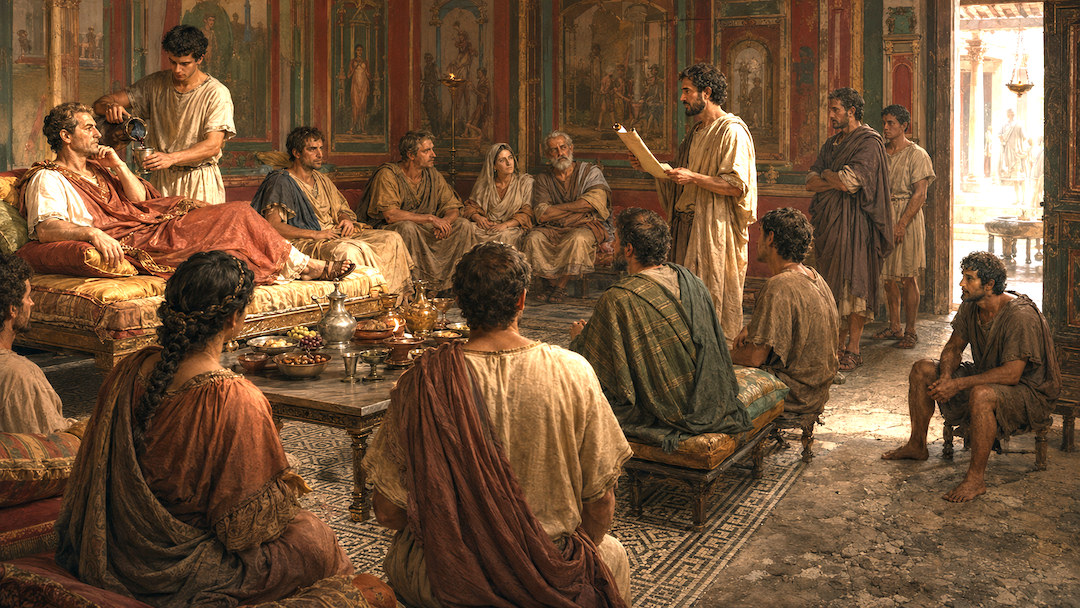
THE BEST COUCH
A formal dining room in a Roman house was called a triclinium, which means “three couches.” There is a lot to the triclinium that we won’t get into today, but what we do need to know is this: where you reclined carried rank. The couch you were given, and the place you were assigned on that couch, announced your social worth to the whole room. Honor had geography. And everyone in the room knew it.
Let’s learn more about Quintus Aurelius, my historically informed character who helps us see Roman honor from the inside.
He was born into an extremely wealthy family that had earned its money through international trade. He built on his ascribed honor by growing a small fortune of his own through his olive oil presses.
Now imagine Quintus becoming a follower of Jesus through Priscilla and Aquila. Before Claudius expelled the Jews from Rome, maybe he first met them through trade, his olive oil for their leather goods. Business becoming conversations. Conversations becoming friendship. Somewhere along the way, they shared the Good News about Jesus the Messiah, and Quintus believed.
For a while, he learned the teachings of Jesus in their home, until the Emperor kicked them out of Rome with the rest of the Jews (Acts 18:1–3). Once they were gone, Quintus began hosting a group of Gentile Christians in his own house. And now, years later, the Jewish believers have returned, Paul’s letter has arrived, and Jewish and Gentile Christians are gathering together again.
This afternoon, he was hosting a reading of Paul’s letter. And you can know, as the well-honored, wealthy merchant, from an honored family, he was on the couch with the highest honor (on the far left of the above picture).
Now follow me across the room from the high honor couch. Past the medium honor couch. Past the so-so couch. Past the benches for common folk. All the way over to the door, standing behind the lowly street vendor. There’s Davus, a slave who had become a follower of Jesus, too.
He was the property of another wealthy merchant a few streets away. That’s how he became aware of the reading at Quintus Aurelius’s house that afternoon.
Davus owned nothing.
In the eyes of Rome, he was property… that breathed.
A tool with a tongue.
In Rome's ledger of who-counts and who-doesn't,
Davus just... didn't.
Now hold Quintus Aurelius and Davus in your mind.
Look around the room for a second.
They have already heard Paul’s letter read from 1:1 through 12:9.
Quintus is still reclining where Rome says he belongs.
Davus is still standing where Rome says he belongs.
Everyone in the room is quietly agreeing with the arrangement
because that is how the world works.
And then the reader gets to 12:10.
“Love each other with genuine affection, and take delight in honoring each other.”
Take delight, Paul?
In honoring each other?
For Quintas, that would have landed on his ears like news that his olive presses were full of rancid oil.
Quintus understood honor the way every Roman did. There was only so much of it to go around. Honor was one loaf at a crowded table, and every slice you handed someone was a slice off your own plate.
Honoring “up” was the exception because it was transactional. You flattered the magistrate, you kissed the ring of the senator, because their shine rubbed off on you.
But honoring “down”?
To have the cup of Davus filled first?
Heck, for Davus to even have a cup!
Getting off of the high couch to wave a slave over to sit on it, unthinkable.
Quintus could practically feel his and his family’s honor leaking out the door that Davus stood beside.
Now, Paul says to get joy out of outdoing each other in giving honor away.
He is reaching for the most hoarded currency in their entire world, honor, and telling them to give it to others, even the people the empire had crossed off.
Paul is naming an infection in the bloodstream of the church: Rome's honor/shame system. It had trained them to rank each other. To know who mattered, who mattered more, and who barely mattered at all. And Paul is prescribing the antibiotic.
Rome does not get to arrange the room!
12:10 flattens the church's internal hierarchical tension. The Roman house churches mixed senators, freeborn, freedmen, and slaves under one roof. "Outdo one another in honor (delight in)" tells high-status members to honor those the culture rates as worthless. Honor stops tracking birth, wealth, or office.
Quintus Aurelius and Davus, and all the believers in Rome, were equal in the baptismal waters, buried with Christ and raised as equals from the watery grave into the family of God.
WHAT ABOUT US?
We still know how to rank people. We know who impresses us. We know who annoys us. We know who is useful and who is not. And we certainly know how to ignore the second group.
So, how does this simple verse of Romans 12:10 challenge us?
Honor is giving dignity to another person through your attention: your ear, your words, your time, an invitation to your table, all communicating, “You matter here.”
Notice who you instinctively rank beneath you. We may not write out a list, because if it accidentally fell out of our Bible at Life Group, that could get pretty embarrassing. But we know. We know who we give extra attention to because of their job, their income, or their role at church. And we know who we quietly ignore because of their lack of education, lack of money, or social awkwardness.
Honor the person who cannot advance you. The one who needs more than they can give. The person who cannot do a thing for your reputation. The one who will never be a strategic connection.
Stop confusing usefulness with worth. Some people are easy to value because they can do things. They can lead. Teach. Give. Sing. Organize. Fix stuff. Make decisions. But the church is not a machine. A person’s worth is not measured by how helpful they are to your team’s ministry.
BAPTISM EQUALIZES US
Before rich or poor. Before polished or messy. Before useful or difficult. Before leader, volunteer, giver, struggler, new believer, old believer, impressive story, complicated story. Baptism got there first. Buried with Christ. Raised with Christ. Named with Christ. Brought into the same family. So when the world hands us its seating chart, the church has to hand it back.
CLOSING NOTE:
So why did I spend an entire article on the second half of a single verse?
Because it is so easy for us to miss that Paul is setting the spiritual posture they will need for everything that comes next. From 12:10b to the end of the letter, Paul is going to walk straight into the stuff that was pulling this church apart: arguments over who can eat and drink what, holy days, judging believers they disagree with, the role of the government, and everyone being sure they saw each issue correctly.
Before he gets to the points of tension among them, Paul tells them how to approach the people they are frustrated with because of those disagreements.
So when the next argument comes, the question is not simply, “Who is right?” And it is certainly not, “Who outranks whom?” The question is, “How do I go first in honoring my brother or sister in Christ?”
If we understand this, the rest of Romans stops sounding like a list of rules. We can finally read it for what it is: Paul applying his first eleven chapters of theology to divided believers, learning how to live as one family.
(For more about the first half of verse 10, see the last 5 minutes of the video below.)
©2026 Greg McNichols, All rights reserved.
Click here to connect with Greg McNichols - Bio and Links