


Greg Stories
A collection of Greg's written stories and teachings
for learning, leadership, and personal growth.

Popping Off at the Mouth?
Do you ever pop off at the mouth? You have no intention of addressing a problem lovingly. You’re just provoking.
“Are you seriously just going to sit there while I do all of this?”
“Of course you forgot. You always do.”
“I hope you realize how frustrating you are to deal with.”
“Why would I expect anything different?”
You know exactly what you’re doing. You’re not trying to solve anything. You’re stirring it up. Can Proverbs help us? Read/Watch at this link.

Paying Interest Philippians 2:1-4
When did the spouse beside you start feeling like the person across from you? Who is keeping score in your house? How much do you want to get your way?
Paul wrote Philippians 2:1–4 to a healthy church that had quietly stopped working like a team. Marriage is the smallest Christian community. It comes apart the same way. And the word Paul chose for humility would have sounded like an insult. Read or watch to discover how these four verses give us clear direction.
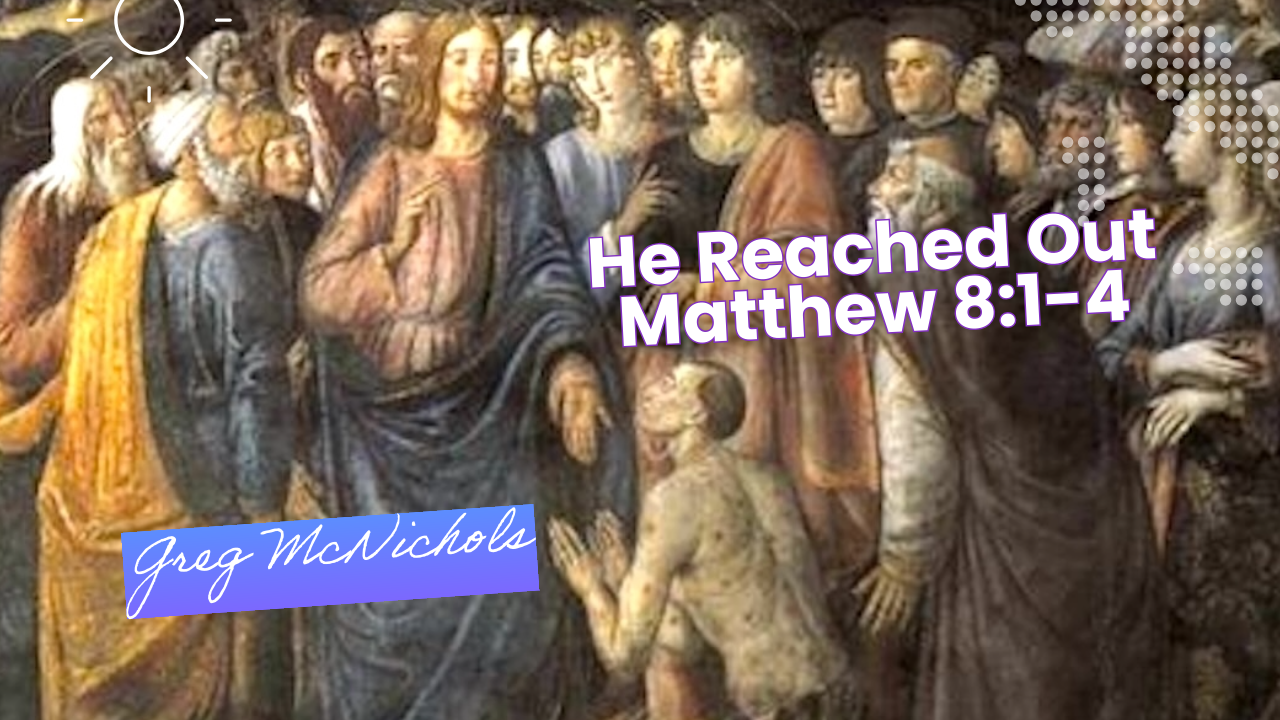
He Reached Out, Matthew 8:1-4
Jesus did not simply heal one man that day. He showed us the direction of the Kingdom.
For centuries, uncleanness pushed people farther away. Jesus came and started moving toward them instead.
For centuries, the distance barrier kept the unclean at the edge. Jesus crossed that distance. Then, through His death and resurrection, He removed it.
Now He lives in us, who believe in Him.
That means the direction of our lives should look like His. We move toward people, not away from them. We cross the distances that fear, shame, sin, and unbelief have created. We do not wait for people to find their way to Jesus. We carry the presence of Jesus toward them.
Every one of us knows someone who feels like they belong outside the camp. Someone convinced them that they have wandered too far. Someone who cannot imagine that God would ever move toward them. Someone who has rejected Jesus, doubts He is who He has claimed to be, or has never truly considered that He might be.
So let us be the people who take the first step. Let us cross the street, the office, the neighborhood, the lunch table, or the family divide. Let us move toward the spiritually lost with the same compassion Christ showed the leper.
Because every time we move toward someone with the hope of Christ, we remind the world which way the Kingdom moves.

Politics, Patriotism, and the Kingdom
IMAGINE WITH ME: Zohran Mamdani (NYC Mayor, Democratic Socialist, and Muslim) and Ben Shapiro (right-wing conservative commentator and Jew) both accepted Jesus last week, are new Christians this week, and have made Newstart Church their home.
Today, I am going to take them both to lunch as their first pastor. Given what they do for a living, I want to help them understand biblically how their new faith impacts their Patriotism, Politics, and the Kingdom of God.
Let's sit down at the table at a Mexican restaurant, order a flight of tacos, and listen in on my conversation with them.
Closing Romans
Paul spends fifteen chapters on the most magnificent theology ever put on paper, and then he lands the whole thing on something almost embarrassingly ordinary. He does not end with a lecture. He ends with a household.
Therefore, accept each other just as Christ has accepted you, so that God will be given glory. —Romans 15:7
Church, that is the assignment. Not believing the right things and heading home. Becoming the kind of people who can actually sit at the same table.
Paul knew how hard that was, because the Roman church was a room full of people who could not agree.
Some ate the meat, some would not touch it.
Some guarded the holy days, some treated every day the same.
Real convictions. Strong feelings.
Paul never tries to make them think alike.
He just flatly refuses to let them look down on each other.
We have watched believers who love Jesus split over a mask, a ballot, a worship style, a school decision, and treat the disagreement like it was a salvation issue. Paul says enough. Welcome the person you would never have picked. Christ already did exactly that for you.
Let’s make room for the one whose politics irritate us,
whose past embarrasses us,
whose questions unsettle us.
Let’s not allow our table to be too small.
Now, let’s go set the table.
WEAK BROTHERS
We often take our personal convictions, read them into Scripture, and then make them a Christian litmus test. So what do you do when people of genuine integrity read the same Bible, love Jesus, and land on opposite sides of serious issues? Let's turn to Romans 14 and see what we can learn.
Before you repost it, repeat it, confront someone about it, or quietly judge someone over it, ask: Is this Scripture, or is this my conviction? Is this sin, or is this my opinion? Am I helping my brother or sister stand before Christ, or am I just trying to win them to my personal conviction?
HOSPITALITY
For the gospel, hospitality is about others, not us. Welcoming and befriending the stranger means I stop making my image the center of the invitation. The question is no longer, “How will I be seen?” The question becomes, Who needs to be seen? Who needs to be noticed? Who needs to be welcomed? Who needs a seat, a conversation, a meal, a friend, a family, a place to belong? That is the shift Paul is calling us to make. Hospitality moves us from protecting our image and convenience to pursuing and welcoming the stranger.
HONOR IN ROME
What did Paul say to Christians in Rome whose culture hoarded honor the way we hoard money? And what does it quietly ask of us? Romans 12:10 contains an antibiotic for an infection that taught an entire empire to rank human worth. Find out how the first listeners heard Paul, why it matters to the rest of Romans, and why we still need the cure. Romans 12:10, Romans 12:9-13
Living Sacrifice
Living sacrifice? Although familiar to many Christians now, why would that have sounded so strange to the first people who heard Romans 12:1? In their world, sacrifice had smoke, fire, and dead animals. Paul takes that familiar sacrifice picture and turns it toward us: our ordinary lives and our church community.
My Past Will Not Define Me
Is your past defining you? Is it living in your mind as regret, shame, or failure? The thing you did. The thing that was done to you. The gospel does not pretend your past was small. It declares that your past does not determine your present. Let's learn from the Apostle Paul's life in Acts 8 and 9.

I’d Have Done More With That Situation
What do you do when you cannot change your situation? In Joseph and Abigail’s stories, bad situations became preparation. In Genesis 39–41 and 1 Samuel 25, betrayal, delay, and injustice do not waste. God uses them. This teaching explores how to make the most of a season you did not choose, and how faithfulness in hard places is never wasted.
Easter Is Everything To Us
Today, I want to help those of you who are not followers of Jesus see why Easter still grabs us Christians by the heart. For some of you, I get how Easter might seem like just another cultural expression of just another organized religion. You may see our faith as something we were raised into, or maybe as something some of us came to later in life because we needed a crutch to get through a lackluster life. I understand how you might see us making a big deal out of Easter every year and assume it is just an emotional experience we stir up in ourselves.
And yes, that may be true for some cultural Christians you have known. But today I hope you will see that it is not true for us.
The reason Easter has its grip on us is that we came to believe that what happened in the life, death, and resurrection of Jesus changes everything for us. We celebrate that every day, and we make a really big deal of it on Easter. Romans 6:1–11 puts words to it for us.
All Things Work Together For Good?
Yes, our prayer life is celebration, adoration, and petition. But it is also lament. Without lament, prayer skips over part of the work God wants to do with us. Romans 8:28 calls us deeper into life in the Spirit, through prayer, in the middle of our suffering, the suffering of others, and the groaning of all creation.
Unity Through Life In The Spirit
Paul is writing because the Roman church is extremely strained by Jew vs Gentile tensions that intensified after Claudius kicked the Jews out of Rome for 5 years, and when the Jews returned, their church had become gentile centric. So Paul steps in and says belonging to God’s family is not grounded in ethnicity, ancestry, or any other Jew vs Gentile boundary markers. It is grounded in the Spirit.
Romans Recap and Start of Chapter 8
Sermon Notes Linked. YOU ARE NOT SAVED BY WORKS. YOU ARE SAVED FOR WORKS. Romans 8 and A Recap of 1-7.

The Problem Beneath the Problem
Romans 5:12-21 doesn’t complement our instincts. It diagnoses them, then points to a bigger hope. An honest look at sin, death, progress, and the gospel.
When Trust Is Enough
What if doubt makes you question whether you even belong to God? This teaching explores how performance, guilt, and quiet pressure distort our view of salvation, and how Romans 4 cuts through the shadows of doubt with a clearer, freer view of Salvation by Faith.

When Moral Clarity Becomes a Hiding Place
Romans 1 and 2 were never meant to be a weapon swung at outsiders. They were an inside-the-family clarification and teaching. What happens when the spotlight we aim at everyone else suddenly swings back toward us? And what if the passages we quote the loudest are the ones meant to expose something in us? We’ll see as we learn from Romans 2.
A Slave Of Christ Jesus
In the first sentence of this very important letter, Paul places himself at the lowest social position imaginable and ties it, unapologetically, to Jesus. In the mind of the first Roman Christian readers, it’s a collision. Paul drags the Roman obsession with power and honor straight into the open and then flips it by naming a different Lord. Before Rome can decide who Paul is, he tells them who owns him. And that choice alone signals that everything they think they know about power, freedom, and status is about to be redefined.
Paul is a free Roman citizen who could have led with his credentials. Instead, he chooses to be a slave in a world where slaves hoped for release, for independence. He adopts the identity willingly. Not once, but repeatedly (Rom. 1:1; Phil. 1:1; Titus 1:1; Gal. 1:10).
Reverse Expectations
Why does the Old Testament sometimes feel confusing, strange, or disconnected from everyday life? A walk through Haggai 2:10–14 during Advent invites us to sit with that tension and discover why these ancient questions still matter more than we think.